
IWP (IID)_Design Repository_2.0 is a contemporary reinterpretation of the famous Design Repository established during the first decades of the Institute of Industrial Design’s existence. Founded in 1950 by Wanda Telakowska, the Institute was instrumental in modernising post-war Poland. It combined research, design, and industry while developing implementation expertise and raising quality standards. The original Design Repository, located on the Institute’s campus at Świętojerska Street in Warsaw, gathered reference designs and documentation that supported collaboration with manufacturers. Records of material decisions, testing procedures, and functional models created an institutional memory of design processes that has since ensured the Institute’s continuity.
Today, it returns as a distributed platform that connects the Institute, designers, and manufacturers capable of producing prototypes. The Institute provides access to its archives, assembles teams and stewards the process; designers translate historical methods into new solutions, while manufacturing partners contribute materials, technologies, production expertise, and insight into implementation potential. Heritage becomes an active resource, while an open network of competences and production facilities evolves into a prototype workshop. Here, modernism is a method rather than a style: form emerges from process, while durability grows out of the relationship between design, production, and use.
The first project developed within this model is ‚visteria for mediolan_warszawa’. The presentation during the Milan Design Week at Torre Velasca was its first public verification; the Warsaw edition at the Gawronski Villa is going to complete this inaugural cycle. The prototypes are undergoing constant technological refinements, with some receiving new colourways and textile finishes.
The IID’s design team – Agnieszka Stefańska, Maria Jeglińska-Adamczewska, Katarzyna Kempa, Daniel Kraszewski, Paweł Jasiewicz, and Jan Garncarek – are reinterpreting materials from the Institute’s archive: from the iconic convertible sofa bed (Amerykanka), and the Płucka (Lungs) chair to historical documentation and functional models. The thinking embedded in these objects – about use, durability, scale, and the relationship between form and function – are translated into new materials and technologies, resulting in prototypes and research objects. The IWP (IID)_Design Repository_2.0 places Poland’s modernisation experience within the broader European conversation about manufacturing quality, responsible supply chains, and the role of design in the economy. As Europe redefines its industrial base, design becomes an infrastructure of trust, combining product quality with process transparency, manufacturing expertise, and commitment to sustaining both. Polish modernism contributes the capacity to integrate research, design, and implementation within enduring institutional frameworks.
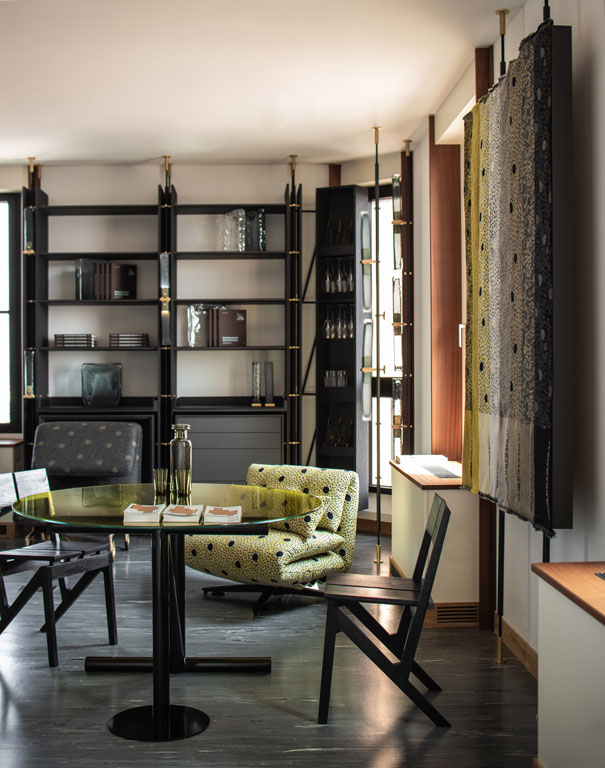
IWP_Wzorcownia_FURN_U_60.26_01_A.S./D.K.
Project conceived: 1960
Realised: 2026
Original concept and design of the modular furniture system: Agnieszka Stefańska
Design of the modular system and moving mechanisms: Daniel Kraszewski
Produced by: Forner, Ango, Noti, Krosno, themost.pl / Tkalnia Olejnik
The project is a reinterpretation of the iconic wall unit (meblościanka), adapted to the realities of contemporary lifestyles and technologies. The all‑in‑one modular system integrates the functions of sleep, relaxation, work, and physical exercise, responding to the demands of micro and hybrid living. Created as part of the Institute of Industrial Design’s IWP (IID)_Design Repository_2.0, it transforms the historical heritage of Polish design into an intelligent solution for the contemporary compact home.
IWP_Wzorcownia_FURN/FD_SE/RE/SL_60.26_01_A.S./D.K.
Project conceived: 1960
Realised: 2026
Original concept and design: Agnieszka Stefańska
Design of the modular system and moving mechanisms: Daniel Kraszewski
Produced by: Noti, Ango, themost.pl / Tkalnia Olejnik
An integral part of the wall unit and, at the same time, a standalone, movable piece of furniture, this multifunctional seating/reclining module can serve as a seat, a chaise longue, or a bed.
As it can be stored within the wall‑unit structure, it remains a concealed yet fully accessible component of the system. The modules can be combined into larger configurations – from a freestanding sofa to a double bed.
IWP_Wzorcownia_LTG_26.26_01_J.G./A.S.
Project conceived: 1960
Realised: 2026
Design: Jan Garncarek and Agnieszka Stefańska
Prototype: Jan Garncarek, Krosno Glassworks
The lighting system consists of light modules that “click in”, allowing for quick and intuitive shaping of light within an interior. Each module contains a replaceable LED component charged via USB‑C, and a glass lampshade available in various colours and finishes.
The lamps can function as standalone table lights, but can also be integrated into the wall unit’s shelving system or mounted on a dedicated light column, creating subtle, luminous spatial divisions. Dedicated wall and ceiling brackets are also available, offering complete freedom in shaping the atmosphere of a room according to individual needs.
Each shade is hand‑blown at the Krosno glassworks. Within it, the light source is concealed and further enclosed in a brass casting. The gently rippled surface of the glass softly diffuses the light, producing a warm, ambient glow.
IWP_Wzorcownia_FURN_SE/RE/SL_55.26_01_K.K.
Project conceived: 1955
Realised: 2026
Design: Katarzyna Kempa
Produced by: Noti, themost.pl / Tkalnia Olejnik
The Polka Dot design is a contemporary reinterpretation of the convertible sofa bed (amerykanka) from 1955, conceived with multifunctionality and small spaces in mind. Thanks to its movable elements and adjustable backrest, the piece adapts to the rhythm of daily life, serving as a seat, daybed, or bed. The design includes a historical accent: a textile by Danuta Paprowicz‑Michno, designed in the 1950s at Warsaw’s Institute of Industrial Design.
IWP_Wzorcownia_FURN_TBL_58.26_01_M.J‑A.
Project conceived: 1958
Realised: 2026
Designer: Maria Jeglińska‑Adamczewska
Produced by: Ango
A graphic interpretation of a textile by Danuta Paprowicz‑Michno, designed at the Institute of Industrial Design in the 1950s. The characteristic dot and triangle motifs have been transformed into a minimalist metal base made of tubes and steel cutouts. The colourful glass tabletop echoes the textile’s neon palette, achieving a new form with minimal use of material.
IWP_Wzorcownia_FURN_CHR_56.26_01_P.J.
Project conceived: 1956
Realised: 2026
Designer: Paweł Jasiewicz
Produced by: Paweł Jasiewicz
A contemporary interpretation of the Płucka (Lungs) chair designed in 1956 by Maria Chomentowska at Warsaw’s Institute of Industrial Design. The original, with its cold‑bent plywood mounted on a box frame with turned, tapered legs, became one of the symbols of the post‑war thaw: an emblem of organic form, material experimentation, and structural flexibility.
Krzesło_Lippu abandons organic plywood in favour of raw geometry, focusing on the essence of the construction – the springiness that arises from its structure. The flexible frame redistributes tension and adapts to the user’s body, while the economical use of material emphasises function rather than decoration.
IWP_Wzorcownia_FAB_57.26_A_01_D.P.M./A.S.
Project conceived: 1957
Realised: 2026
Designer: Agnieszka Stefańska
Produced by: Iza Sojka – themost.pl / Tkalnia Olejnik
This series of textiles is a contemporary reinterpretation of patterns developed at the Institute of Industrial Design in the 1950s. The starting point was a design by Danuta Paprowicz‑Michno, created as part of research into machine‑printed textiles. In engaging with the heritage of Polish design, Agnieszka Stefańska reworks the historical motif using contemporary tools, lending it a new texture and palette.
IWP_Wzorcownia_FAB_51.26_A_01_D.D./A.S.
Project conceived: 1951
Realised: 2026
Designer: Agnieszka Stefańska
Produced by: Iza Sojka – themost.pl / Tkalnia Olejnik
This textile series reinterprets patterns developed at the Institute of Industrial Design in the 1950s. The starting point was a design by Danuta Dybowska, drawing on folk traditions, particularly the paper‑cut art of the Opoczno region. In her reinterpretation, Agnieszka Stefańska emphasises geometricized plant forms, creating a rhythmic composition built on repetition of motifs.
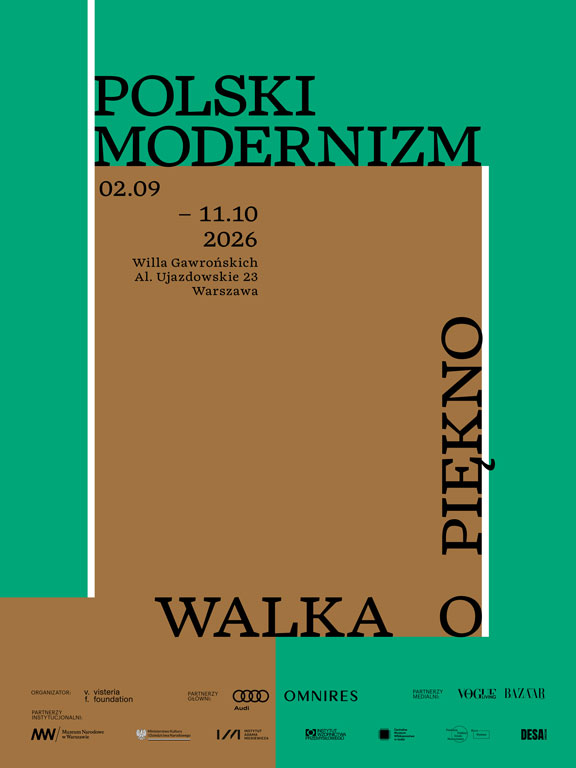
2 Sep -11 Oct 2026
Gawrońscy Villa – Al. Ujazdowskie 23, Warsaw
Curators
Anna Maga @ann.amaga
Federica Sala @lafedesss
Exhibition Design
Zofia Wyganowska Studio @zofiawyganowskastudio
Zofia Wyganowska
Weronika Wilkowska
Graphic Design
Stefania Kolanowska @stefkolanowska
Typesetting and Layout
Monika Proniewska @monika.proniewska
Project Management and Production
Matylda Polak @matyldapolak
Set Design
Jędrzej Iwanicki – Studio Projektowe Pracownia
Wall Prints
Jakub Jaździk – Dandywall
PR and Communication
Szymon Machnikowski @szymonmach
International – GA | Guga + Anil @gacreativeconsultants
Poland – Royal Heroes @royal__heroes
Creative Consulting
Hanna Rydlewska @haniarydlewska
Copyediting
Aleksandra Boćkowska @aleksandrabockowska
Anna Maga
Małgorzata Czyńska @malgorzata_czynska_official
Translation
Joanna Figiel @figiel_j
Institutional partners
The National Museum in Warsaw @nationalmuseuminwarsaw
The Adam Mickiewicz Institute @mickiewicz_institute
The Institute of Industrial Design @instytutwzornictwa_iwp
Central Museum of Textiles in Łódź @centralnemuzeumwlokiennictwa
Polish Modern Art Foundation @fundacjapsn
DESA Unicum @desa_unicum
Main partners
Omnires @omnires_official
Audi Polska @audipl
Media partners
Vogue Polska Living @vogue.polska.living
Harper’s BAZAAR Polska @harpersbazaarpolska
Partners of IWP (IID)_Design Repository_2.0:
Co-financed by the Polish National Foundation @polska.fundacja.narodowa
FORNER @forner.pl
ANGO @ango_meble
NOTI @noti_furniture
KROSNO GLASS @krosnoglass
themost.pl @themostpl
TKALNIA OLEJNIK
PERA
PENT @pent_luxury_fitness

Architect and expert at the Institute of Industrial Design in Warsaw. Her career encompasses architecture, interior design, photography, graphic art, and visual arts. She studied at the Faculty of Architecture at Warsaw University of Technology, the Open Academy at the Academy of Fine Arts in Warsaw, and the ZPAF Photography School in Warsaw, where she earned two diplomas with honours.
She is the founder and Vice-President of the Association of Interior Architects since 2018, and a member of several distinguished professional bodies, including the Association of Visual Artists ZAP, the International Association of Art, the Association of Polish Artists and Designers (ZPAP), and the Association of Polish Art Photographers ZPAF. She maintains an active presence in the artistic community, participating in numerous competitions both as a contestant and as a juror.
IG: @infinidesign

Designer, graduate of ECAL in Lausanne, and expert at the Institute of Industrial Design in Warsaw. For a decade she was affiliated with the London studio Barber Osgerby, where she honed her craft across a wide range of international design projects. Since returning to Poland, she has pursued projects at the intersection of traditional craftsmanship and modern production. She serves as Creative Director of the Krosna brand and as a collaborating designer at the Institute of Industrial Design, where she actively supports the advancement of Polish manufacturing.
IG: @_kasiakempa_

Doctor of Arts, teacher at the Faculty of Design at the Academy of Fine Arts, and expert at the Institute of Industrial Design in Warsaw. A graduate of the Faculty of Furniture Design and Technology at Buckingham New University in High Wycombe, United Kingdom, and the Faculty of Design at the Koszalin University of Technology. A furniture designer, artist, carpenter, and sculptor, he is also the founder of Fiku Toys – a brand producing hand-crafted wooden balancing figures. As a researcher, he explores woodworking techniques and their impact on material culture, alongside designing furniture and collectible objects. His achievements include a Red Dot Award, an artistic grant from the Ministry of Culture and National Heritage, and an honorary Master of Artistic Crafts diploma bestowed by the Minister of Culture.
IG: @pawel_jasiewicz

Designer, PhD in innovation strategy and processes from Loughborough University, founder of aleto.design, and expert at the Institute of Industrial Design in Warsaw. His innovative designs and products have earned him the prestigious Red Dot and iF Awards – and he has been recognised by British institutions including the Royal Academy of Engineering and the Institution of Engineering Designers. Having worked in several research and development centres of global tech giants such as Dyson, he now assists ambitious start-ups and companies achieve their business goals through innovative product development.
He serves as curator of the Dobry Wzór (Good Design) competition and as a technical expert in the Polish Agency for Enterprise Development’s Polish Product of the Future competition, championing the highest standards of design excellence in both.
IG: @aleto.design
LN: @aleto.design

Designer of collectible objects whose aesthetic navigates the intersection between sculpture and design, and expert at the Institute of Industrial Design in Warsaw. He graduated from the Academy of Fine Arts in Warsaw with a Master of Fine Arts from the Faculty of Design in 2012, having also studied at the Politecnico di Milano between 2010 and 2011. After gaining experience across several design disciplines, he founded his own practice – Jan Garncarek Design – in 2016. His work brings together massive, organic forms and refined detailing to produce a striking visual language that is at once recognisable and consistent. Every object is made by hand, in short, numbered editions, produced either in his own studio or in close collaboration with specialist craftspeople. His work can be found in galleries across Europe and the United States.
IG: @jan_garncarek_design

Designer and expert at the Institute of Industrial Design in Warsaw. She studied industrial design at ECAL in Lausanne, where she was awarded an IKEA Foundation scholarship. In 2012 she founded the Office for Design & Research – a studio whose practice spans industrial design, research projects, and exhibition-making. Her collaborators have included Ligne Roset, Kvadrat, Vitra, Hermès, Puro Hotels, the London Design Festival, the Adam Mickiewicz Institute, and the Museum of Modern Art in Warsaw.
Her work has been exhibited in Poland and abroad, with appearances at the Design Museum, Centre Pompidou Metz, Villa Noailles, and the Triennale di Milano. Between 2018 and 2020 she served as Creative Director of the Arena Design fair in Poznań. In 2025, she co-founded the brand GestGest.
IG: @mariajeglinska